Worktop vs Undercounter Refrigerator for Commercial Kitchens

Last Updated: November 22, 2026
Quick Summary
A worktop refrigerator is the better choice when you need a usable prep surface on top of the cold box, while an undercounter refrigerator suits cold storage where you want to save floor and wall space. The right pick depends on how your line actually moves during service.
- Worktop models give you a usable prep surface and often include a 4-inch backsplash.
- Undercounter units have no usable top, but fit tight spaces under existing counters.
- Measure the opening at its narrowest point, including face frames and door swing.
- Confirm whether the unit is front-breathing or rear-breathing before enclosing it.
- Score each station on prep surface, storage, wall protection, and ventilation before deciding.
Table of Contents
- Worktop vs Undercounter Refrigerator: Quick Comparison
- What Is a Worktop Refrigerator and What Is an Undercounter Refrigerator?
- Undercounter Refrigerator Sizes, Widths, and Storage Capacity
- Undercounter Refrigerator Installation Clearance and Ventilation Checklist
- Commercial Refrigerator Prep Space: Using the Top Surface and Backsplash
- Reach-In vs. Undercounter Refrigerator: Which Fits Your Workflow
- Choosing Between a Worktop and an Undercounter Unit for Your Kitchen Layout
- Booking Your Refrigeration Selection at Mediterranean Restaurant Equipment
- Frequently Asked Questions
Worktop vs Undercounter Refrigerator: Quick Comparison
A worktop refrigerator is the better pick when you need a usable prep surface on top of the cold box. An undercounter refrigerator is the better pick when you only need cold storage and want to save floor and wall space. The decision comes down to how your line actually moves.
| Feature | Worktop Refrigerator | Undercounter Refrigerator |
|---|---|---|
| Top surface | Usable prep surface | Typically closed or limited |
| Backsplash | Often included (4" in listed models) | Usually none |
| Storage capacity | Around 9.5 to 11.8 cu. ft. in listed models | Around 9.5 to 11.8 cu. ft. in listed models |
| Best for | Prep stations, sandwich lines | Bar backs, tight storage spaces |
Pros of worktop refrigerators:
- Gives you a prep surface and a backsplash in one unit
- Keeps ingredients cold while you work on top
- Fits prep-heavy stations like sandwich and salad lines
Cons of worktop refrigerators:
- Takes up more counter height than a standard undercounter unit
Pros of undercounter refrigerators:
- Fits under existing counters with minimal disruption
Cons of undercounter refrigerators:
- No usable top surface for prep
What Is a Worktop Refrigerator and What Is an Undercounter Refrigerator?
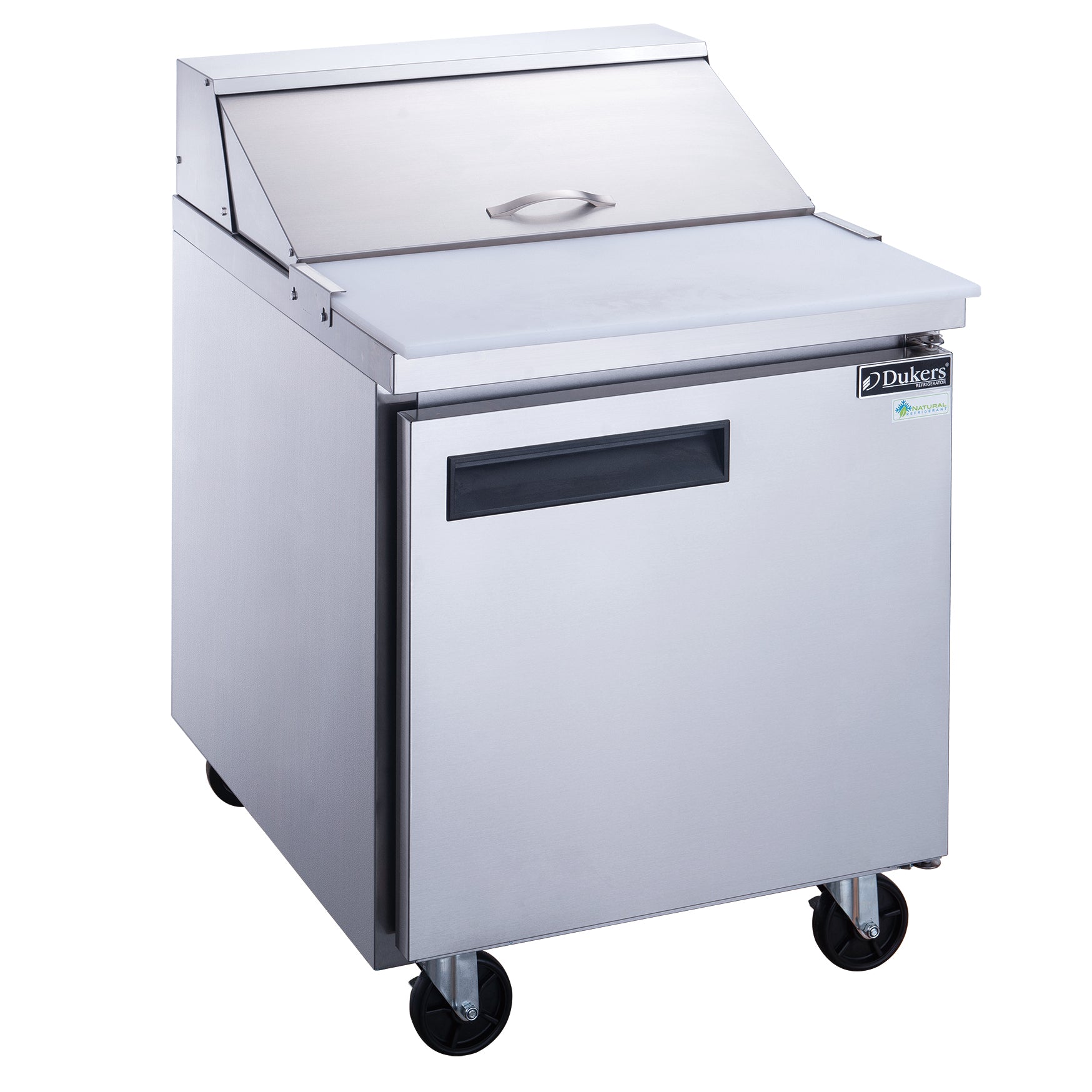
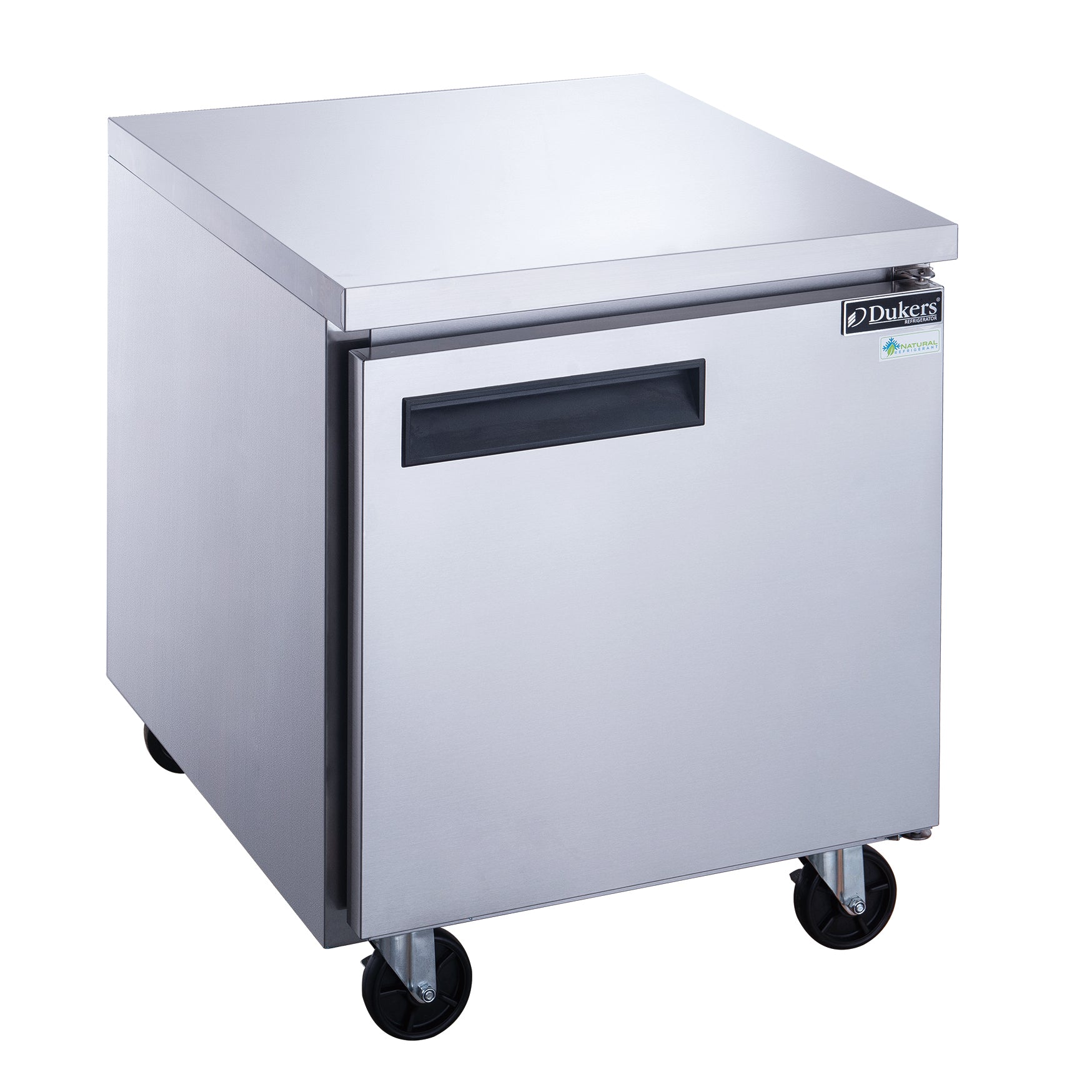
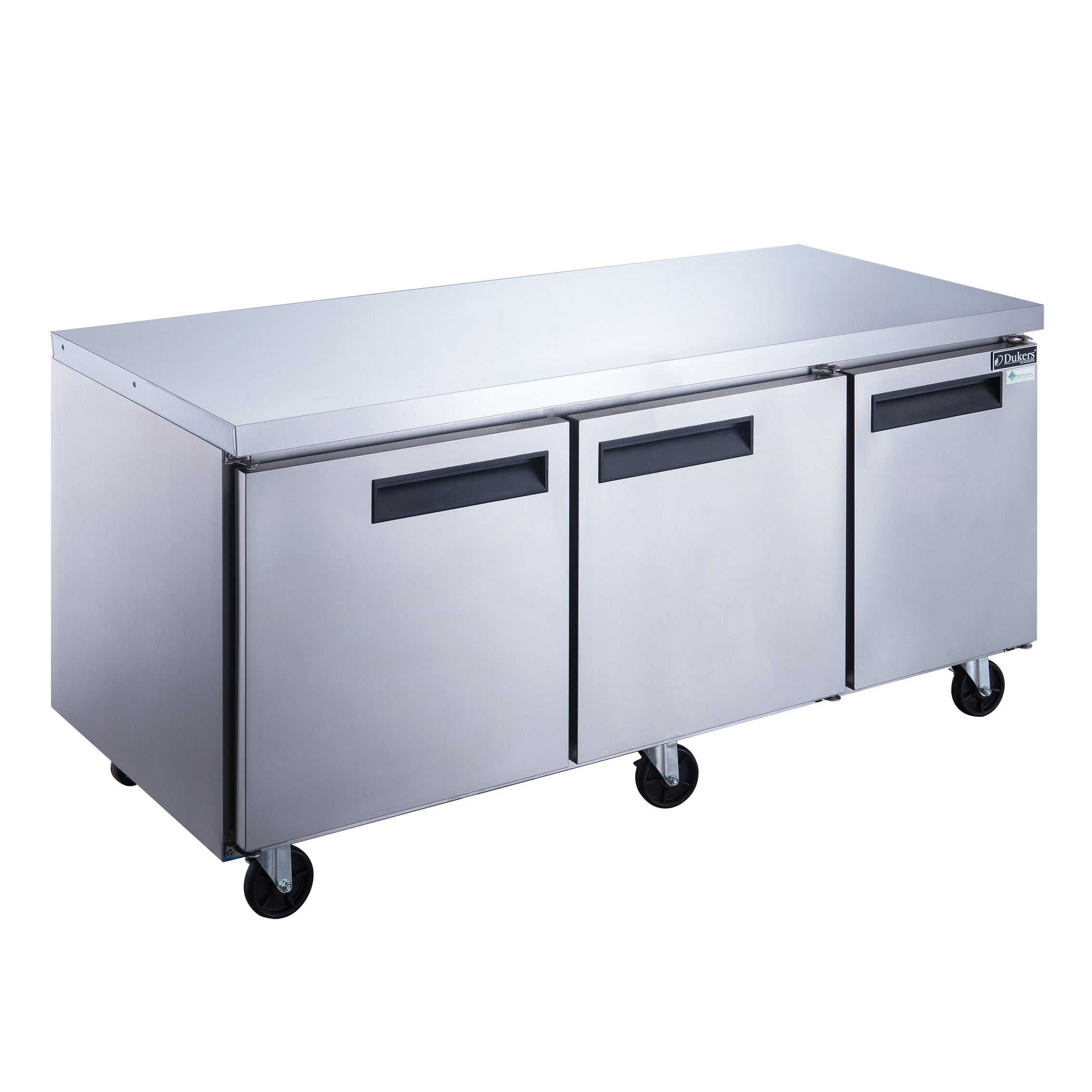
A worktop refrigerator is a commercial refrigeration unit with a flat, durable top that you can use as a work surface. An undercounter refrigerator is a commercial refrigeration unit designed to sit beneath a counter with the top closed off. The listed Fagor and Beverage Air models use self-contained refrigeration, with front-breathing or rear-mounted airflow depending on the model.
The Fagor FWR-27-D2-N, for example, is a worktop model with a 4-inch backsplash and two drawers that accommodate 6-inch-deep pans. Its undercounter counterpart, the Fagor FUR-27-D2-N, uses the same 27-3/4-inch width and 9.5 cubic foot capacity but without the work surface.
Choosing between them starts with asking one question: do you need a surface on top of the cold box?
Undercounter Refrigerator Sizes, Widths, and Storage Capacity
Undercounter refrigerators come in a range of widths and door configurations. Two-section models, such as the Beverage Air UCR48AHC, offer 48 inches of width and 11.82 cubic feet of capacity with two doors and four shelves.
Single-section models like the Fagor FUR-27-D2-N run narrower, at 27-3/4 inches, with 9.5 cubic feet of capacity. Measure the space under your counter before ordering, including the depth where the unit will sit.
Many kitchens find that a 27-inch unit fits a single station, while a 48-inch unit suits a longer line or a bar back. Your menu volume and how often staff restock during service should guide the choice.
Undercounter Refrigerator Installation Clearance and Ventilation Checklist
Installation is where worktop and undercounter units diverge most, and it is the step most buyers underestimate. The airflow path that cools the condenser differs between models, and that path dictates how tightly you can enclose the unit.
Front-breathing versus rear-breathing airflow. A front-breathing unit pulls air in and pushes heated air out through a grille at the toe kick or lower front panel, so you can push the cabinet back against a wall or drop it into a tight counter run. A rear-breathing unit draws air across the back and needs open space behind it; enclosing it with a solid back panel traps heat and forces the compressor to run longer. Confirm the airflow direction in the spec sheet before you frame the opening.
Clearances that actually matter. Manufacturers publish minimum clearances for the front grille, rear, and sides, and those numbers are not interchangeable between models. Do not assume a 27-inch unit drops into a 27-inch opening; door swing, hinge side, and cord routing all consume space. Measure the opening at the narrowest point, including any face frame, and measure depth to the wall.
Heat discharge and the enclosure problem. A refrigerator moves heat from inside the box to the room. In a sealed cabinet or tight alcove with no return air, that heat recirculates and the condenser cannot reject it efficiently, causing longer run times, higher energy use, and temperature swings. If you must enclose the unit, plan a vent path at the front and a way for hot air to escape, and check the manual for the maximum ambient temperature rating.
Electrical requirements. Confirm the circuit before delivery. Check the nameplate and manual for each model's electrical requirements, since amp draw and circuit needs vary by model. Check the nameplate and manual, and confirm the outlet is reachable without pulling the unit out, a short cord or buried outlet is a common fit failure.
Common fit problems to check before ordering:
- Airflow direction confirmed (front-breathing or rear-breathing) against the enclosure you plan
- Opening measured at the narrowest point, including face frames and door swing
- Depth measured to the wall, with the specified rear clearance added
- Front grille unobstructed and not blocked by a toe kick or cabinet panel
- Ambient temperature rating of the unit matches the kitchen's summer conditions
- Electrical circuit, amp draw, and outlet location verified against the nameplate
- Unit leveled on casters with brakes engaged, and doors checked for self-closing alignment
A worktop unit adds one more consideration: the top surface and backsplash raise overall height, so confirm the finished counter height works for staff and that the backsplash does not collide with wall-mounted shelves, outlets, or a hand sink.
Commercial Refrigerator Prep Space: Using the Top Surface and Backsplash
The top surface of a worktop refrigerator gives you a prep area above the cold box.
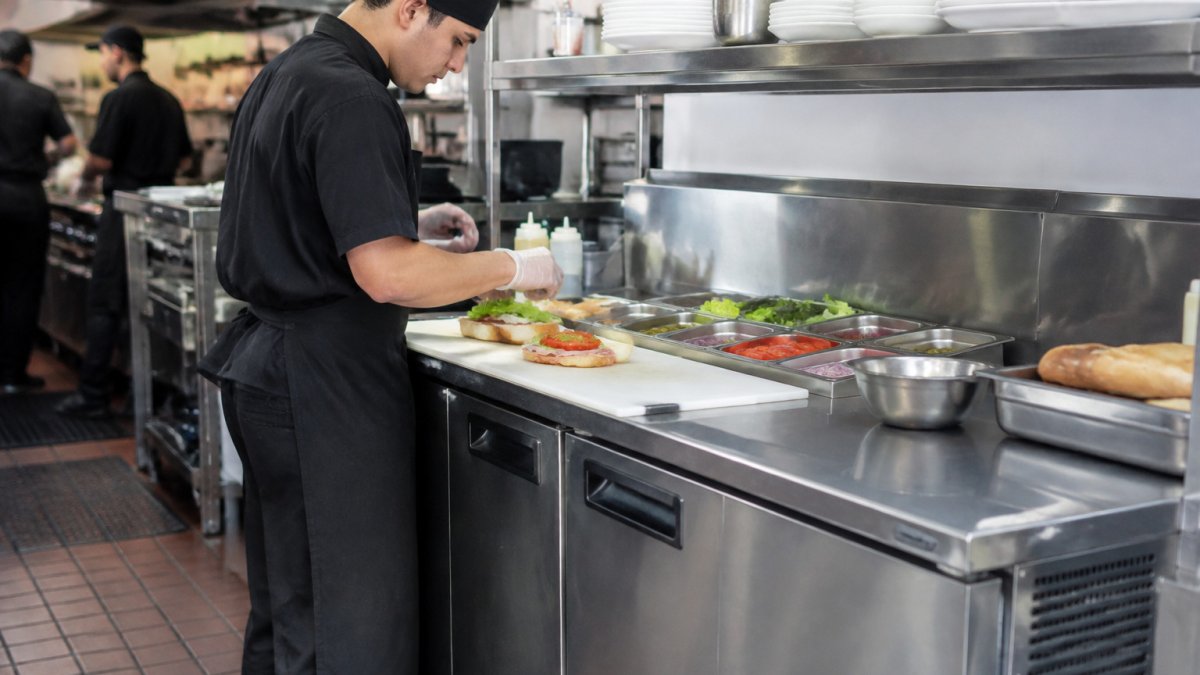
The Beverage Air WTR48AHC includes a 4-inch removable backsplash.
Plan the top surface around your actual prep tasks. A station that handles cold salads needs different space than one that builds burgers.
Reach-In vs. Undercounter Refrigerator: Which Fits Your Workflow
A reach-in refrigerator is a full-height unit with doors you open to access stored food. An undercounter refrigerator is a short unit that sits under a counter and keeps items at arm's reach.
The Beverage Air WTR48AHC and similar worktop models sit between the two, giving you storage and a work surface at counter height. To compare against a taller option, you can view reach-in refrigerator options alongside these models.
Choosing Between a Worktop and an Undercounter Unit for Your Kitchen Layout
Score the station against measurable criteria using the matrix below.
Decision matrix: score each criterion for your station
| Criterion | What to measure | Favors worktop | Favors undercounter |
|---|---|---|---|
| Available floor footprint | Width and depth of the opening, in inches | Wider runs that can take a 48-inch unit | Tight openings, often 27 inches or less |
| Required storage capacity | Cubic feet needed for a day's par | Larger capacity when paired with a prep line | Smaller par, frequent restocking |
| Prep surface need | Square feet of top surface the task requires | Portioning, sandwich and salad assembly | Plating or storage only |
| Wall protection | Whether the wall behind the station takes splash | Backsplash protects the wall | No backsplash needed |
| Ventilation path | Front-breathing clearance available | Front-breathing with backsplash against wall | Front grille must stay open |
| Door configuration | Doors versus drawers versus combos | Drawers for pan access at prep height | Doors for shelf storage |
| Countertop equipment | Weight and footprint of slicers, mixers, scales | Only if the top is rated for the load | Equipment sits on the adjacent counter |
| Lifecycle cost | Purchase price plus energy and service over life | Higher upfront, offset by prep labor saved | Lower upfront, storage-only value |
How to read the matrix. Count the criteria that favor each type for the specific station, not the kitchen as a whole. A bar back that only stores garnishes and bottled product will score almost entirely toward undercounter. A sandwich line that portions cold cuts and builds salads all shift will score toward worktop on prep surface, backsplash, and door configuration, even if the footprint is similar. The Fagor FWR-27-D2-N and FUR-27-D2-N share a 27-3/4-inch width and 9.5 cubic feet of capacity.
Map the station to the task, not the room. Walk the line and note where staff stand, reach, and set things down. A cook who portions ingredients directly over the cold box saves steps every ticket; a cook who only restocks gains nothing from a worktop and loses counter height. The question is which unit removes the most motion from the busiest task at that station.
Check countertop equipment compatibility before you commit. A worktop surface is not automatically rated to carry a slicer, mixer, or other heavy equipment. Confirm the load rating and surface construction in the spec sheet, and remember that equipment on the top blocks the prep area you bought the unit for. If the station needs both a slicer and a prep surface, the slicer usually belongs on an adjacent table.
Factor lifecycle cost, not just sticker price. Purchase price is the visible number, but energy use, service life, and maintenance change the comparison. Check the unit's energy consumption and expected service life in the spec sheet before you compare models.
A short decision sequence:
- Measure the opening at its narrowest point and confirm the airflow direction the space allows.
- Estimate the cubic feet of product the station holds between restocks.
- List the prep tasks performed at the station and whether they need a top surface.
- Check whether the wall behind the station needs splash protection.
- Confirm any countertop equipment has a home that is not the refrigerator top.
- Compare purchase price plus energy and expected service life for the two finalists.
If the station scores toward worktop on prep surface, backsplash, and door configuration, a worktop model such as the Fagor FWR-27-D2-N is the better fit. If the opening is tight, the par is small, and the station only stores, an undercounter model like the Fagor FUR-27-D2-N makes more sense. Walking the line during a busy service remains the fastest way to validate the matrix.
Booking Your Refrigeration Selection at Mediterranean Restaurant Equipment
Mediterranean Restaurant Equipment can help you compare worktop and undercounter options against your kitchen layout. Browse the worktop refrigerator collection to see single-section and prep-table models, or check the undercounter refrigerator options for widths and storage capacity.
Visit our showroom to see these units in person before you commit.
Frequently Asked Questions
What is the difference between a worktop refrigerator and an undercounter refrigerator?
A worktop refrigerator has a usable stainless steel top surface, often with a removable backsplash of about 4 inches, so it doubles as a prep station. An undercounter refrigerator is built to sit beneath an existing counter and typically has no usable top, so the countertop above it stays in place. Both use similar self-contained refrigeration systems. Choose a worktop unit when you need extra prep space on the line, and an undercounter unit when the counter is already set and you need hidden cold storage.
Can you use a worktop refrigerator as a prep surface?
Yes. A worktop refrigerator provides a flat top surface for prep work. Check the spec sheet before placing heavy equipment on it. Models like the Fagor FWR-27-D2-N and Beverage Air WTR48AHC add a backsplash that helps keep splashes off the wall.
How much storage space does an undercounter refrigerator provide?
The Fagor FUR-27-D2-N offers 9.5 cubic feet in a 27-3/4 inch single section with two drawers, while the Beverage Air UCR48AHC provides 11.82 cubic feet across two sections in a 48 inch width. Compare cubic feet against the number of pans you store daily.
What should you measure before installing an undercounter refrigerator?
Measure the width, depth, and height of the opening, then add the clearance the manufacturer specifies for airflow. The Fagor models are listed as front-breathing, so check the spec sheet for the front clearance required. Confirm the power outlet location before installation.
