7 Things to Check Before Buying a Used Commercial Oven

Quick Summary
Before buying a used commercial oven, confirm the utility match, inspect the gasket and interior, run a heat-up test, check gas flames and airflow, test every control, and get the warranty terms in writing. Run the oven at full heat under load, since some failures only show up once it is working.
- Read the data plate and match voltage, phase, gas type and BTU input to your building's service.
- Check the door gasket for cracks, hardening or gaps, since a poor seal causes uneven baking.
- A unit that holds within 10 to 15 degrees of set point for 15 minutes is behaving normally.
- A yellow, lifting or lazy gas flame points to a dirty burner, wrong orifice or pressure problem.
- Confirm who pays return freight, because shipping a heavy oven can erase the warranty's value.
Table of Contents
- Why a Used Commercial Oven Can Be the Smarter Buy
- Used Commercial Oven Types and Where Each Fits
- Commercial Oven Inspection Checklist Before You Pay
- Commercial Oven Lifespan and What Drives It
- Used Commercial Convection Oven Buying Considerations
- Used Restaurant Equipment With Warranty: What to Ask For
- Choosing Your Used Oven From Our Current Inventory
- Frequently Asked Questions
Why a Used Commercial Oven Can Be the Smarter Buy
A used commercial oven can cost a fraction of a new one and still do the same job for years. For restaurant owners in New Jersey and New York who are outfitting a new kitchen or replacing a failing unit, a used oven is often the most practical place to start. Mediterranean Restaurant Equipment sells new and used commercial restaurant equipment, and our used inventory includes several oven types.
Used equipment carries a few clear advantages. The purchase price is lower, which leaves more budget for the rest of the build-out. A well-maintained oven from a reputable line often has years of service left.
The trade-off is condition. A used oven can hide heating problems, worn door gaskets or a control board nearing failure. That is why the rest of this guide focuses on what to check. Buyers who inspect carefully tend to get the savings without the surprises.
Used Commercial Oven Types and Where Each Fits
Choosing the right type matters more than choosing the cheapest unit. A convection oven, a deck oven and a cook-and-hold unit solve different problems, and buying the wrong one wastes money no matter how good the price.
Convection ovens circulate hot air with a fan, which cooks food evenly and quickly. They suit kitchens that roast, bake and finish a broad menu. Electric convection models, such as the Southbend ES/20CCH, are designed for a 208V three-phase electrical supply.
Double-deck ovens give you two independent cooking chambers, so you can bake two products at different temperatures at once. The Blodgett 961 is a natural gas double deck oven.
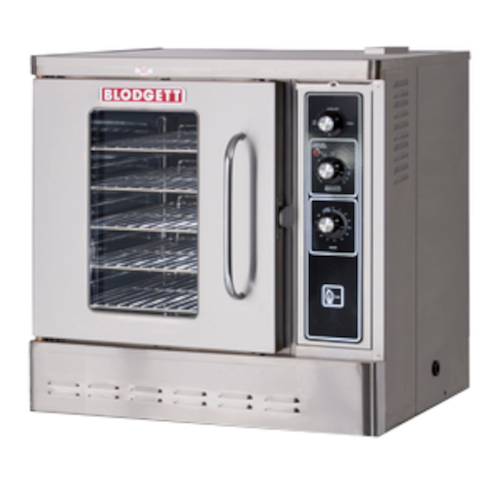
The Bakers Pride Y-602 is a natural gas double deck pizza oven.
Cook-and-hold ovens keep prepared food at serving temperature for extended periods. The Alto-Shaam 750-TH/II is an undercounter cook and hold oven.
The NU-VU SUB-123 is a double deck electric oven proofer combo.
The article's oven types and their stated fit, summarised for quick comparison.
| Oven type | Best for | Key detail |
|---|---|---|
| Convection oven | Roasting, baking and finishing a broad menu | Circulates hot air with a fan |
| Double-deck oven | Baking two products at different temperatures | Two independent cooking chambers |
| Cook-and-hold oven | Keeping prepared food at serving temperature | Holds food for extended periods |
Commercial Oven Inspection Checklist Before You Pay
Used oven listings often lack detail on performance and repair history, and the checklist below helps you verify condition yourself. Run it in order, because each step depends on the one before it.
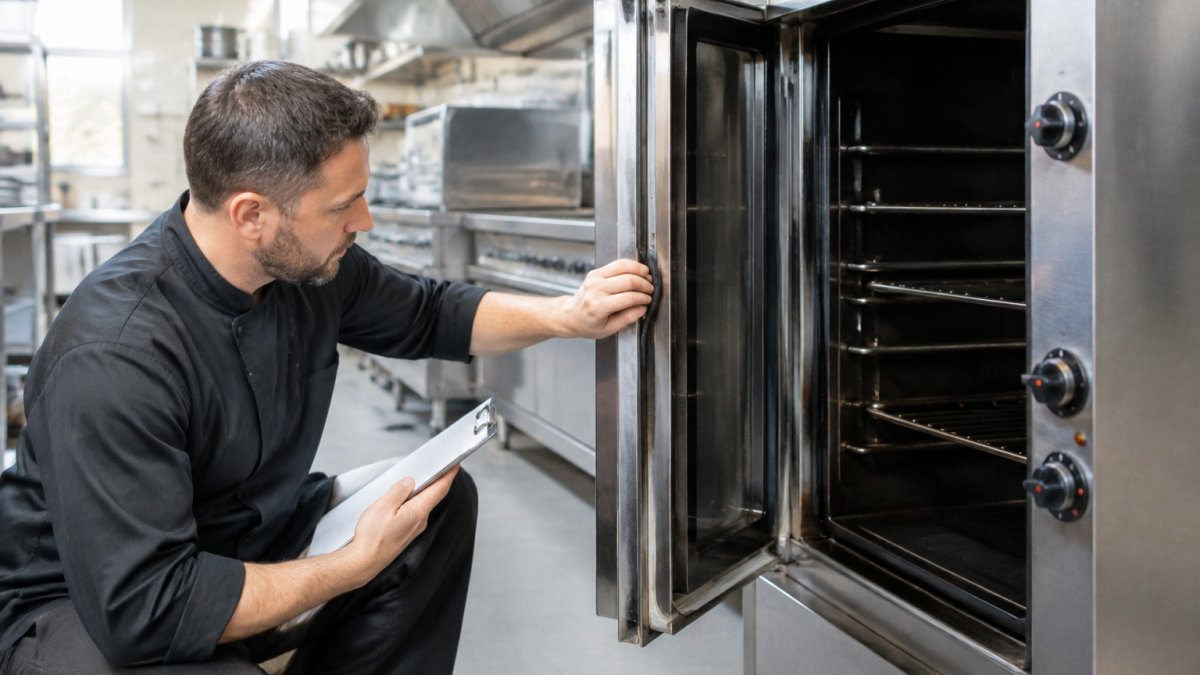
Step 1: Confirm the utility match before you touch the unit. Read the data plate and write down voltage, phase, amperage, gas type (natural or LP), manifold pressure, and BTU input. Compare those numbers to your building's service. A 208V three-phase convection oven will not run on a 120V circuit, and a natural gas unit will not run on propane without a conversion kit. If the plate is missing or unreadable, treat that as a fail and move on.
Step 2: Cold inspection. With the oven off and cool, open the door and check the gasket for cracks, hardening, or gaps at the corners. A gasket that does not seal lets heat escape and causes uneven baking. Look at the interior for cracked enamel, heavy scale, or corrosion that has eaten into the metal. Confirm every rack and shelf slides smoothly and that the rack guides are not bent. On deck ovens, check the deck surface for cracks or warping; a cracked deck is a costly replacement.
Step 3: Power-on and heat-up. Turn the unit on and set it to a mid-range temperature, not full heat. Watch the display or thermometer and time how long it takes to reach the set point. A unit that climbs steadily and holds within about 10 to 15 degrees of the set point for 15 minutes is behaving normally. A unit that overshoots hard, drops sharply, or never reaches the set point has a thermostat, element, or burner problem.
Step 4: Gas-specific checks. Light each burner and confirm the flame is blue with a steady cone. A yellow, lifting, or lazy flame points to a dirty burner, a wrong orifice, or a gas pressure problem. Listen for the ignition sequence: a click, a whoosh, and a steady flame is normal. Repeated clicking without ignition, or a smell of gas, is a stop sign.
Step 5: Convection and airflow. On convection units, run the fan at each speed setting and listen for grinding, rattling, or a bearing whine. Confirm air moves through the cavity and that the fan reverses if the unit has a reversing feature. A fan that runs but does not move air usually means a blocked wheel or a failing motor.
Step 6: Controls and safety systems. Press every button and turn every knob. Digital displays should not flicker, reset, or show error codes during the test. Confirm the door switch shuts off the fan or heat when the door opens, and confirm the high-limit safety cuts heat if the unit overheats. These are the systems that protect your staff, and they are the ones sellers most often skip.
Step 7: Document the result. Photograph the data plate, the interior, the flame (on gas units), and the display at temperature. Write down the time to reach set point and any noise or error you observed. If you are buying remotely, ask the seller for a short video that shows the same sequence, and compare it to your notes when the unit arrives.
Watch out: a unit that powers on and lights is not the same as a unit that holds temperature under load. Run it at full heat for at least 15 minutes and, if possible, put a load of product in it, because some failures only appear once the oven is working.
When you buy at auction or from a remote seller, ask whether the unit has been tested, whether it is sold as-is, and what return terms apply.
Commercial Oven Lifespan and What Drives It
Heating elements and igniters are usually the first parts to wear. Door gaskets degrade with heat and handling, and fans can develop bearing noise over time. Regular cleaning, especially of burner ports and vents, prevents the grease buildup that shortens equipment life.
Ask the seller for the unit's service history and any repairs made.
Used Commercial Convection Oven Buying Considerations
Convection ovens are among the most common used purchases, and a few specific factors matter when you shop for one. Start with capacity: the interior size and number of racks should match your peak production, not your average day.
Next, confirm the utility requirements. Electric convection ovens often need a dedicated circuit with specific voltage and phase. Gas units need the correct gas type, adequate supply pressure and a compliant vent. Have an electrician or licensed gas technician confirm the installation requirements before you buy.
Finally, compare the control type. Digital controls offer precise temperature and programming, while analog controls are simpler to repair. Consider which your staff will use most comfortably.
Used Restaurant Equipment With Warranty: What to Ask For
Warranty terms on used ovens vary by seller, so confirm the terms before you buy.
Dealer sales. Ask the dealer what warranty applies, what is excluded, and whether it is honored on-site or requires shipping the unit back. Ask for the warranty in writing before you pay, and confirm whether it transfers if you resell the unit.
Auction and online marketplace sales. Read the auction's terms carefully, including the removal window and whether the unit was tested. Ask for the condition notes in writing before you bid.
Private sales. Get the serial number, ask for the service history, and ask whether the unit was in service until recently. Confirm return terms before you pay, and rely on the inspection checklist above.
Questions to ask in every channel. Does the price include delivery and installation, or is that extra? What is the return window, and who pays return freight? Is the unit sold with any testing documentation? What is the parts availability for this model, and how long does a replacement control board or igniter take to arrive? A model with a long lead time on parts can cost more in downtime than it saved on purchase price.
What to get in writing. Ask for the warranty term, the covered components, the excluded components, the return window, the delivery and installation terms, and the condition notes. A one-page written summary is enough. If a seller will not put the terms in writing, treat the warranty as nonexistent and negotiate the price accordingly.
Watch out: a warranty that requires you to return a 500-pound deck oven to the seller is worth less than it appears, because freight and crating can erase the savings. Confirm who pays return freight before you rely on the warranty.
Choosing Your Used Oven From Our Current Inventory
Once you know the oven type, the electrical or gas requirements and the condition checklist, shopping becomes much simpler. Start by matching the unit to your menu and volume, then compare price against the condition details you have confirmed.
Our current used inventory includes the Southbend ES/20CCH electric convection oven at $3,200.00, the Alto-Shaam 750-TH/II cook-and-hold oven at $1,995.00, the NU-VU SUB-123 double deck proofer combo at $4,500.00, and two double-deck units: the Blodgett 961 natural gas oven and the Bakers Pride Y-602 pizza oven, each at $10,000.00.
If you are not sure which unit fits your kitchen, contact our team for help with layout and equipment selection. Mediterranean Restaurant Equipment helps restaurant owners find used commercial ovens that match their space, budget and operating needs.
Frequently Asked Questions
Where can I find commercial ovens for sale?
Commercial ovens are sold through restaurant equipment dealers, showrooms, and online equipment retailers, and many also come from restaurants that have closed or upgraded. Buying in person lets you see the oven running, check its condition, and confirm it fits your kitchen's gas or electric hookup. Mediterranean Restaurant Equipment carries new and used units at its Union and Burlington, New Jersey locations, so you can compare models side by side before committing.
What is the lifespan of a commercial oven?
A well-maintained commercial oven often lasts well over a decade, and some heavy-duty deck and convection models run far longer. Lifespan depends on how hard the oven is used, how often it is cleaned and serviced, and whether gas burners, thermostats, and door seals are kept in good repair. When evaluating a used unit, ask how many years it was in service and whether it has been professionally maintained.
What should I inspect before buying a used commercial oven?
Check the door seal, heating elements or burners, thermostat accuracy, and the interior for rust or cracks. Run the oven through a full heat cycle and confirm it reaches and holds temperature. Look at the control panel, fan operation on convection models, and the power or gas connection requirements against your kitchen's utilities. Ask the seller for the unit's service history and any repair records.
Do used commercial ovens come with a warranty?
Warranty coverage on used commercial ovens varies by seller, so ask before you buy. Some dealers offer a limited warranty on parts and labor for a set period, while others sell as-is. Get the warranty terms in writing, including what is covered, how long it lasts, and whether labor is included.
How much does a used commercial oven cost?
Prices depend on oven type, size, fuel source, and condition. At Mediterranean Restaurant Equipment, current used listings include a Southbend ES/20CCH electric convection oven at $3,200.00, an Alto-Shaam 750-TH/II undercounter cook and hold oven at $1,995.00, a NU-VU SUB-123 double deck electric oven proofer combo at $4,500.00, and a Blodgett 961 natural gas double deck oven and a Bakers Pride Y-602 natural gas double deck pizza oven, each at $10,000.00. Compare the price against the oven's condition and what it will cost to install and run.
Current used oven listing prices
